
How to Use Fake Blood (+ Easy DIY Recipe)
Most people go looking for a blood recipe a day or two before the party, with the costume hanging up and nothing red in the house. Mix 4 tablespoons of golden syrup with a cornflour paste, around 20 drops of red food colouring and 2 drops of blue. That’s how to make fake blood that […]

Most people go looking for a blood recipe a day or two before the party, with the costume hanging up and nothing red in the house.
Mix 4 tablespoons of golden syrup with a cornflour paste, around 20 drops of red food colouring and 2 drops of blue. That’s how to make fake blood that reads as blood rather than jam. Cocoa powder darkens it, and extra cornflour thickens it for drips.
Mad About Horror supplies professional-grade blood to scare attractions, stage productions and film sets across the UK and Europe, so we know where a kitchen batch works and where it gives up. Below we’ll cover the recipe, how to apply it, where it’s safe to put it, and how to get it back off again.
Hero — thick red blood dripping down pale skin. Dark, moody, close, black background.
Caption: Thick, dark and slow-moving is what you’re aiming for.
What You Need (and the One Swap UK Kitchens Have to Make)
Nearly every recipe online calls for corn syrup, which isn’t a standard British cupboard item. Golden syrup behaves the same way and is the swap to make. Everything else here is store-cupboard stuff, which is why it’s a staple of doing Halloween on a budget.
- 4 tbsp golden syrup
- 1 tbsp cornflour
- 2 tbsp warm water
- 1 tsp cocoa powder
- Red food colouring
- Blue or green food colouring (a couple of drops, no more)
One thing to sort before you mix: food colouring stains. Wear something you don’t mind ruining and cover the worktop.
Which version you want depends on the job:
- On skin at a party: the syrup recipe below.
- On a white costume you want to keep: the washable version, kept off your face.
- Going near a mouth, or onto a cake: the edible icing sugar version.
- On camera: the same recipe, darker and more opaque, so double the cocoa.
Ingredients laid out on a dark worktop. Golden syrup tin, cornflour, cocoa powder, food colouring bottles.
Caption: All store-cupboard, bar the swap from corn syrup to golden.
How to Make Fake Blood in About Five Minutes
Blend the cornflour into water first, then colour the syrup. Doing it in that order is what keeps the finished mix smooth instead of grainy.
- Stir the cornflour into the warm water until it’s a smooth paste with no lumps. Lumps show up badly once the colour goes in.
- Mix the paste into the golden syrup. It should coat the back of a spoon and fall in a slow ribbon.
- Add red colouring a few drops at a time, stirring between each. Around 20 drops does it for this quantity.
- Add 2 drops of blue or green. Real blood is far darker than post-box red, and a tiny amount of the opposite colour kills the pink without turning it brown.
- Sift in the cocoa powder a pinch at a time. This makes it opaque and pushes it towards the rust tone blood goes as it sits.
- Test it on kitchen roll. Too bright and translucent, add cocoa. Too runny, add more cornflour paste.
The finished mixture on a spoon, showing consistency and how dark the red goes.
Caption: Ribbon off the spoon, opaque, closer to rust than post-box red.
Four Ways to Tweak It
Thicker, for drips and wounds
Add cornflour paste a teaspoon at a time until it holds its shape on a vertical surface. Thick blood sits where you put it, which is what you want around a prosthetic edge or running from a hairline.
Edible, for mouths and cakes
Swap the base for icing sugar mixed with a little water and golden syrup, and colour it exactly as above. Everything in it is food, so it can go in a mouth. It’s also the version to use with children.
Washable, for costumes
Replace roughly half the syrup with clear washing-up liquid. The detergent lifts out of fabric far more readily. This version is not edible and must be kept off the face entirely. You don’t get both properties in one batch.
No syrup at all
Icing sugar and water make a workable blood on their own, thickened with cornflour and coloured the same way. It’s the most realistic of the lot and it stains anything it touches, so treat it as a skin-and-props recipe.
How to Apply It So It Doesn’t Look Like Ketchup
Blood almost never looks right poured on. It looks right when it’s flicked, dripped and dabbed, because that’s how it behaves.
- Drips: use a pipette or a clean medicine syringe. Start high on the forehead or neck and let gravity draw the line for you.
- Splatter: dip a fingertip and flick for large droplets. For fine spatter, drag your thumb backwards across the bristles of an old toothbrush aimed at the surface.
- Grazes: dab with a coarse sponge, torn rather than cut, pressing rather than wiping.
- Handprints: coat your palm thinly, press, then lift straight up so it doesn’t smear.
- Mouth trickles: edible version only, run from one corner of the mouth down the chin.
Let each pass go tacky before adding the next. Layering gives depth, and the same technique works on props if you’re building a fake dead body for the garden.
Where It’s Safe to Put It, and Where It Isn’t
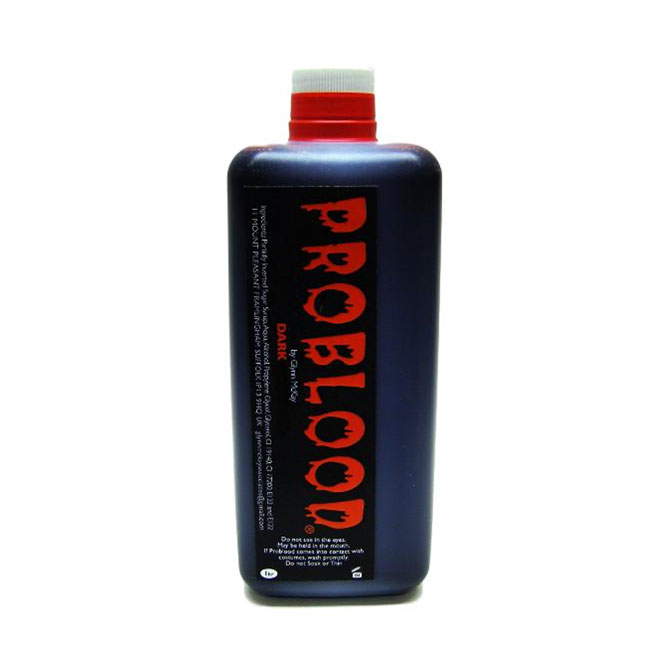
Never near the eyes. Not even blood sold as mouth-safe, because those are separate tests. Our own Glynn McKay Problood is labelled safe to be held in the mouth but not to be used in the eyes, and homemade blood is held to no standard at all. Apply around the socket, never on the lid or lash line, and never above the eye where it can run down. If any gets in, flush with clean water and stop.
The rest of it:
- Mouth: only the edible version. Detergent-based washable blood is not edible and stays off the face completely. Expect dyed teeth and lips either way.
- Patch test 24 hours ahead on the inner forearm, especially for children, sensitive or eczema-prone skin, and any shop-bought product you haven’t used before. Problood’s own guidance says the same.
- Children need the edible recipe and supervision, on skin, off the face, for a short stretch. Professional bloods including Problood contain alcohol and are labelled to keep away from children, so they aren’t a substitute here.
- Don’t sleep in it. Wash it off before bed. The longer dye sits on skin, the more it stains and the more likely irritation gets.
Getting It Off Your Skin, Out of Clothes and Off the Carpet
The dye is what causes the damage, not the syrup. Red 40 in particular clings, which is why cleaning specialists recommend a petroleum jelly barrier on skin before you apply anything.
Skin. Wipe the bulk off with a dry cloth, then work oil, micellar water or shaving foam into what’s left and rinse with warm soapy water. Non-gel toothpaste shifts stubborn patches. Never use nail polish remover on skin — it can irritate skin that isn’t remotely sensitive, and it does nothing the oil won’t.
Clothes. Blot, don’t rub, and use cold water only, since heat sets the dye permanently. Rinse from the back of the fabric so the stain pushes out rather than through. Work in an enzyme stain remover, leave it, then wash cool. Keep it out of the tumble dryer until the mark has gone.
Carpet. Blot from the outside inwards with cold water and a little washing-up liquid, changing cloths as they colour. Lifting most of it in the first minute matters more than anything you do later.
When a Kitchen Recipe Isn’t Enough
A syrup batch is right for a couple of hours at a party. It never sets, so it stays tacky, picks up hair and dust, transfers onto sofas and door handles, and photographs brighter and pinker than blood looks. For a full night out, a shoot, or a shift in a scare maze, it’s the wrong tool.
That’s the point at which professional-grade theatrical blood earns its place. The Glynn McKay Problood we stock is made in the UK, non-staining, washable if the fabric allows, and comes in Original for arterial red and Dark for venous. It’s the blood used by the Royal Shakespeare Company and the National Theatre, and on productions from Casualty à The Batman.
Frequently Asked Questions
What can I use if I don’t have fake blood?
Golden syrup with red food colouring is the fastest substitute, darkened with cocoa or chocolate sauce. Beetroot juice works at a push but runs thin, and red lipstick softened with petroleum jelly suits small smears rather than drips.
Does fake blood stain permanently?
It depends on the dye and how fast you act. Blotting immediately with cold water is worth more than any product you buy afterwards. Once a dyed stain has been through heat, a hot wash or a dryer, it’s usually there for good.
How long does homemade fake blood take to dry?
Syrup-based blood doesn’t really dry. It goes tacky within a few minutes and stays that way, which is why it transfers onto everything. Detergent and icing sugar versions set firmer, but none dry the way shop-bought drying blood does.
Is homemade fake blood safe on skin?
For most people, briefly, yes, because it’s food ingredients. It isn’t tested or regulated as a cosmetic though, so patch test 24 hours ahead, keep it away from eyes, and wash it off before bed rather than sleeping in it.
You’ve now got a blood recipe that looks the part, a way to apply it that doesn’t read as spilled squash, and a plan for the mess afterwards. Mix a small test batch beforehand so you know how your food colouring behaves. If you’re still working through the rest of it, our guide to Halloween party ideas covers everything around it. Have a good one.